

Looking for the ultimate DigitalOcean vs. Linode vs. Vultr showdown? Our comprehensive 2026 VPS analysis cuts through the marketing noise to reveal exactly what each cloud provider brings to the table. We'll also explore why budget-savvy developers are checking out alternatives like SSD Nodes. Let's find out who actually delivers the best bang for your buck, and who's just draining your wallet.
Overview - DigitalOcean vs Linode vs Vultr
DigitalOcean, Linode, and Vultr all deliver high-performance VPS servers with more or less same quality and speed. That said, each has its strengths: DigitalOcean stands out with its extensive 1-click app marketplace and powerful scalability features, Linode has more generous bandwidth allowances and somewhat better all-around support, while Vultr consistently beats the competition on VPS pricing.
DigitalOcean vs Linode vs Vultr vs SSD Nodes
For a detailed breakdown of how SSD Nodes stacks up against Linode, DigitalOcean, and Vultr, we'll examine the 16GB unmanaged VPS plan across all four providers. We'll evaluate each option based on several key criteria:
- What resources do they offer?
- How do the prices compare?
- Which provider offers the best value?
- What do their customers have to say?
To keep things fair, we'll focus on the basic VPS option from each provider.
DigitalOcean calls theirs a Standard Droplet. At Linode, it's a Standard Linode. Vultr goes with Regular Performance server. And at SSD Nodes, it's our Standard VPS. Clearly, nobody's winning any awards for creative naming here!
Is Linode Still Around?
Technically yes, but the Linode brand was retired in 2023 when Akamai completed its acquisition and rebranded the service as Akamai Cloud. The infrastructure is the same, but you're now buying from a much larger enterprise vendor, which comes with enterprise-level pricing and a product roadmap focused on Akamai's CDN and security business rather than developer-friendly VPS hosting.
Notes About This VPS Comparison
Here are a few other things to note:
- We’re looking specifically at 16GB RAM plans because that's the sweet spot for most developers. Enough power to run multiple applications without breaking the bank.
- We’re calculating costs based on at least one full month of usage.
- Digital Ocean, Linode, Vultr, and SSD Nodes all use a KVM hypervisor.
- All of these prices are for unmanaged servers, which means you are responsible for installing applications and managing and maintaining your server.
- Each plan utilizes shared resources, which means your server runs alongside many other servers on a single host.
- All 4 of these providers offer full root access.
- Every plan provides a few Linux distribution (or operating system) options, including Ubuntu, Rocky Linux, Fedora, Debian, and AlmaLinux.
Note: If you are looking for a DigitalOcean alternative, check out Top DigitalOcean Alternatives: Save Up to $1,500 on VPS Hosting.
Comparing resources on 16GB RAM VPS
Let’s look at the offering for the 16GB RAM plans from each provider. The table below has the specs of each provider and the pricing:
| 16GB RAM plans | Linode | DigitalOcean | Vultr | SSD Nodes |
|---|---|---|---|---|
| RAM | 16GB | 16GB | 16GB | 16GB |
| CPU | 6-core | 6-core | 6-core | 4-core |
| Disk | 320GB SSD | 320GB SSD | 320GB SSD | 320GB SSD |
| Transfer | 8TB | 6TB | 5TB | 8TB |
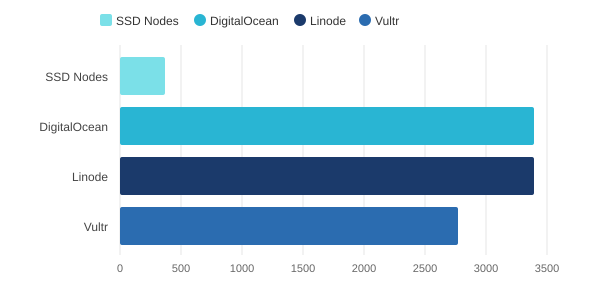
| 3-Year Price | $3456 | $3456 | $2880 | $393 |
The basic stats on these plans are pretty comparable.
DigitalOcean and Vultr fall short on bandwidth compared to Linode and SSD Nodes. And if you accidentally go over your limit, you might get hit with an ugly surprise on your next bill.
SSD Nodes gives you a bit less storage and CPU, but the price is over 88% cheaper than the others. When you look at what you're actually paying per unit of resources (we'll break this down below), the value is incredible.
The best SSD Nodes price (which you see here) requires a 3-year contract up-front, but the cost of those 3 years will cost you the same as 4 months with DigitalOcean, Linode, or Vultr.
VPS Comparison: Who Offers the Best Value for Your Dollar?
One of the most essential considerations when comparing VPS plans is how much value you get for your money.
How much stuff do you get?
What's the bang for your buck?
Who gives you the best return on investment?
Let's crunch some numbers based on the table above. That'll show us which VPS provider gives you the most resources for every dollar you spend.
Resource value comparison VPS plans 2026 (per month):
| 16GB RAM plans | Linode | DigitalOcean | Vultr | SSD Nodes |
|---|---|---|---|---|
| RAM / dollar (MB) | 166 MB/$ | 166 MB/$ | 200 MB/$ | 560 MB/$ |
| Storage / dollar (GB) | 3.3 GB/$ | 3.3 GB/$ | 4 GB/$ | 11 GB/$ |
| Transfer / dollar (GB) | 62.5 GB/$ | 83 GB/$ | 62.5 GB/$ | 280 GB/$ |
1. Ram per dollar
RAM dictates how much your server can handle before it starts struggling. Push past its limits and it starts leaning on disk swap, and that's where things get ugly. Pages hang. Apps freeze. Everything grinds. You want headroom, not a server running on fumes.
In the Linode vs DigitalOcean comparison, both give you 166MB of RAM per dollar. Vultr does a bit better at 200MB per dollar.
SSD Nodes delivers 560MB per dollar. That's more than 3x what you get from any of the others for the same spend.
RAM matters a lot, but it's only part of the picture. Let's look at what else you're paying for.
2. Disk space per dollar
Disk space has endless uses. From large-scale databases to mission-critical backups to photos of your cat Linus. Having plenty of storage is great, but you also want to make sure you're not overpaying for it, especially if you're not planning to fill your VPS with hundreds of gigabytes of data.
Here we'll calculate using GB and you'll see that—once again—DigitalOcean, Linode come out in a dead heat at 3.3GB per dollar, while Vultr offers 4GB.
SSD Nodes does offer less total storage space, but at 11GB per dollar, they still deliver 3x the value for your money. So, if you're not planning to need ALL the storage that the others offer, there is tremendous value there.
3. Transfer (bandwidth) per dollar
Transfer is how much data flows in and out of your VPS each month.
Every time someone visits your site, loads your app, or streams anything you're hosting, that counts against your monthly allowance. Most users won't come close to burning through it. Even a terabyte is a lot for typical workloads. But it's still worth knowing what you're actually getting per dollar.
This is where the Linode vs DigitalOcean vs Vultr picture gets more interesting. Linode leads the three pricier options on bandwidth, but SSD Nodes matches Linode's generous 8TB/month allocation at a fraction of the cost.
Total Cost of Ownership Comparison for 16GB VPS Plans
We’ve found that most VPS users aren’t as interested in running a single server for an hour as they are a long-term, reliable server that they can use over a long time. With that in mind, it makes sense to consider the total cost of ownership for the 16GB RAM plans with each provider.
Let’s dig into how much you’ll spend over 1 month, 1 year, and 3 years:
| 16GB RAM plans | Linode | DigitalOcean | Vultr | SSD Nodes | Savings with SSD Nodes |
|---|---|---|---|---|---|
| After 1 month | $96 | $96 | $80 | $28 | $68 |
| After 1 year | $1152 | $1152 | $960 | $159 | $900+ |
| After 3 years | $3456 | $3456 | $2880 | $393 | $3000+ |
When looking at these numbers, it's important to remember that each of these options are offering a nearly identical base product, in terms of what you get for your money. They do each have slightly different feature sets, some dashboards may be more intuitive than others, they offer different backup options, etc.
But three of the four are offering almost identical pricing, while the other could save you over $3,000 in just 3 years.
How We Keep Our Prices Low
At SSD Nodes, we deliver enterprise-grade VPS hosting at a fraction of the market price through three key advantages:
1) Vippy: Our custom-built VPS hosting technology optimizes resource sharing and boosts performance, giving you faster load times and rock-solid reliability.
2) Strategic Data Center Partnerships: We partner with industry leaders like Hivelocity to access 40+ data centers across six continents. By working with established network providers, we get enterprise-grade infrastructure without enterprise-grade overhead.
3) Expert Team & Efficient Operations: Our lean, expert team constantly innovates to maximize efficiency. We skip the flashy marketing and focus on what matters - delivering top-tier VPS hosting at prices that make our competitors scratch their heads.
DigitalOcean Customer Reviews
Despite the high price labels, DigitalOcean is known for top-notch servers, and this clearly shows in their Excellent 4.6 star rating on Trustpilot.
What Are the Disadvantages of DigitalOcean?
DigitalOcean's biggest weakness is cost, you're paying a premium for branding and UX polish that more experienced developers don't really need. Beyond that, bandwidth overages can catch you off guard, and their managed database and app platform pricing adds up fast if you go beyond basic VPS usage. It's a great onboarding experience, but users who outgrow the hand-holding often find themselves overpaying.
Linode Customer Reviews
Linode used to be considered a leading VPS provider, but it appears they are recently experiencing significant growing pains, especially with their fraud detection system. Although long-term customers praise their reliability and support. But new customers face frustrating account creation problems, and many reported instant fraud flags even after payment verification. Support quality also seems inconsistent.
Vultr Customer Reviews
Final Verdict: The Best Value VPS for 2026?
I hope you have a better understanding of how each player in the Linode vs DigitalOcean vs Vultr vs SSDNodes VPS comparison stacks up.
The raw numbers don’t lie. And neither do the customer reviews.
We’re quite happy with how SSD Nodes stack up here.
Not to brag, but even our monthly plans are far more cost-effective in the long term AND our customers are happy with the service we're providing. Our satisfied customers avoid overpaying for enterprise-grade VPS performance. They save hundreds—maybe even thousands—every year.
The math is simple: for what you'd pay for 3 months of 16GB RAM VPS with Linode, DigitalOcean, or Vultr you could lock down 3 years with SSD Nodes.
FAQ: DigitalOcean vs Linode vs Vultr vs SSD Nodes
What Is a Cheaper Alternative to DigitalOcean?
Several providers undercut DigitalOcean on price. Vultr being the most common. But for developers who don't need hourly billing and can commit to longer terms, SSD Nodes offers the most dramatic savings: up to 85% less than DigitalOcean on comparable specs, with no surprise bandwidth charges and a lifetime price lock.
Is SSD Nodes really that much cheaper than DigitalOcean, Linode, and Vultr?
Yes! Our 16GB RAM plan costs about the same for 3 years as you'd pay for just 3 months with the other providers. The catch? You'll need to pay upfront for the best deals, but the savings are massive - we're talking over $3,000 in 3 years for comparable resources.
Do all these providers offer the same features?
While we all use KVM hypervisors and provide full root access, there are some differences. DigitalOcean shines with their 1-click apps, Linode offers generous transfer limits, Vultr focuses on competitive pricing, and we at SSD Nodes prioritize offering enterprise-grade VPS at budget-friendly prices.
What if I need help managing my server?
This comparison was for unmanaged VPS services. Meaning you'll need to handle server maintenance and application installation yourself. If you're not tech-savvy, you might want to consider managed hosting alternatives or brush up on your server management skills.
Which provider is best for beginners?
DigitalOcean tends to be the most beginner-friendly with their extensive documentation and 1-click apps. Vultr and Linode can be a bit challenging for newcomers due to their strict security measures. At SSD Nodes, we focus on providing a clean, straightforward dashboard while maintaining competitive pricing.
What about server reliability and uptime?
All providers, including us at SSD Nodes, maintain high reliability standards. DigitalOcean, Linode, and Vultr have long track records of stable performance. While we might be a less known player, we have thousands of customers and they consistently report excellent uptime and performance.
Is Vultr cheaper than DigitalOcean?
Yes — Vultr consistently undercuts DigitalOcean on base VPS pricing. At the 16GB level, Vultr comes in at $80/month versus DigitalOcean's $96. That said, both are significantly more expensive than budget-focused alternatives. Over three years, even the cheaper Vultr option costs $2,880 for the same tier that runs $393 at SSD Nodes.